It is often said, "You can't time the market."
What does this mean?
In general it means you never know what will happen tomorrow.
If you thought the market was ready to slump after its nice run up before 1999 and not invested in the beginning of 1999, in some cases you would have missed the largest one year returns we may ever see in our lifetime. Data courtesy Yahoo Finance for Janus Global Technology fund:
By all accounts, many of the stocks in this fund were trading at prices way above historical averages given what the underlying companies were earning, even before they proceeded to double in value in less than a year.
Stock prices and therefore fund prices are not driven by fundamentals, but by what people are willing to pay. Many people determine what they are willing to pay based on fundamentals, but many people do not. And in either case you still have to guess how you think the economy will do in the future. Had you invested at the beginning of 2000 thinking that this is a new economy and historical valuations do not apply because technology is going to enable corporate growth to expand at levels never before imagined, you would have been very sad by the end of 2002. Again consider Janus Global Technology:
Since 2002, markets around the world have gone up, almost across the board. Small and large company stocks have increased. Growth and value oriented companies have done well. Historically when oil prices have soared, economies have struggled as the added cost of manufacturing and transportation have been factored into the price of goods, lowering sales or reducing profits. Recently this has not been the case as companies across all sectors have grown and earned significant profits. Some claim tax cuts in the US are the cause, but European markets despite much higher taxes have trounced American markets so I am hesitant to attribute any single factor to these trends. Despite a long run of gains, stock price valuations are nowhere near as high as they were in 2000. So what does all this mean?
Beats me, I'm a philosophy major.
Some claim that current valuations are too high as they are calculated anticipating that above average growth will continue for a while which is possible, but unlikely given historical trends.
Some think the economy is ready to pick up steam. Would you trust this guy?
Others say things are not good, not bad.
One of the reasons the hypothetical portfolio I am creating here only holds funds that allow $100 or smaller subsequent investments is to not have to figure out how to time the market. My thinking is that if I buy a fund and contribute $100 every month, every 2 months or once a quarter, the exact timing of each purchase will not have a significant impact over the long term as the cost of the overall holdings will be the average of each purchase through up and down markets. If the sector the fund invests in grows and the fund managers make good picks, I should come out ahead.
I agree that you can not time the market, but you do have to determine a time to make the initial investment. And no advice works in every situation. If you had cash to invest in January 2000, the notion that you can't time the market so just buy when you have the cash, would not have been good advice. So even though I agree with the claim that you can't time the market, there are, good and bad times to invest and more importantly good and bad strategies for investing. And even if you buy into the Wylie idea of regular contributions, you still have to make the initial purchase which for the funds I am looking at are often a minimum of $2500.
So even though you cannot predict how markets will perform there are a couple of tools out there that you can use to see if it is a good time to buy or not and hopefully avoid buying at a market peak.
In part II I will talk about these tools and lay out a strategy for hypothetically investing in the Wylie hypothetical portfolio. Then I will pick the last few funds necessary to round out the portfolio and begin tracking the performance of the portfolio.
MAVERICK MONEY MAKERS
 If you are looking for a easy automated system, developed by millionaires, and proven to generate at least $354.97 per day from home, then Maverick Money Makers may be just what you're looking for!:click here for more information
Thursday, March 26, 2009
When to buy Mutual Funds Part I
Friday, March 20, 2009
Ouch!
In honor of today's massive sell off, I'm changing the picture on my blog. The old picture is down on the right. money
Ironically, the old picture was a bunker on top of Golden Gate Park North of San Fransisco. It's original purpose, I am told, was to serve as a guard post keeping an eye out for dangers from Asia during World War II. money
The pundits say that part of today's bloodbath in US markets was due to a huge sell off in China's stock markets. So perhaps no-one was in the bunker... money
Actually, if you look closer you can see clearly that there are people in the bunker:
I guess they do not know where the "Off" button for the Market is... money
Anyway- my new picture is of a sunset behind the remnants of a forest fire in the Boundary waters Canoe Area. Every now and then, devastation rolls through. Hopefully new growth will come along more healthy and robust (and Green!) than before. money
Thursday, March 19, 2009
The Wylie portfolio vs Lazy and Kevin!
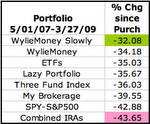
After yesterday's sell off, I went back and looked at the one day performance of my recommendations compared to the lazy portfolio. I anticipated that my managed funds (Well the NTIAX is an index fund but the others are managed) would have under performed Vanguard's low cost index funds. Now let me be clear- this is not an apples to apples comparison. My allocation is not invested in the same categories as the lazy portfolio. But if somone came to me and said- "I want to invest $10,000 in some mutual funds.., any funds worth researching?" These are the one's I would think about... money
After realizing my funds did not lose as much, I ran the numbers on Kevin's actual allocation too. money I am not sure what this indicates exactly- the Vanguard funds invest very broadly so maybe this simply means that yesterday's sell off was very broad and that my funds were a little better positioned for this round. All my stock funds did better than the Vanguard stock funds but the real difference was my bond fund which is a not at all like the broad Vanguard bond fund of the lazy portfolio. money
Anyway- not much use in looking at daily performance of funds for the kind of investing I am exploring- except to be sure you can stomach some sadness. money
Thursday, March 12, 2009
Is the US national debt a problem?
Beats me. I majored in Philosophy, not Economics. My expertise would be more on the question- what does it mean that the US has a lot of debt… or why does debt exist… or if debt goes up and no one is paying attention, does it make a sound? (apparently not!)
Regardless- here is one opinion that thinks the US will soon collapse under the weight of its massive debt. money
Actually, Dr. Chris Martenson fears that the real result will be decrease in the standard of living and skyrocketing inflation as the US tries to print itself out of its debt. money
And here is another opinion that suggests US debt is low, relatively speaking and that the debt doomsday crowd will worry itself to extinction. Actually Mike Norman references Alexander Hamilton and states "…having a national debt is a national treasure, because it's a reflection of a nation's ability to establish and maintain credit.” money
The most telling thing to me, when reading these two opinions side by side, is which sets of numbers each chooses to focus on and how they do not match. Both articles are from 2006 but Dr. Martenson’s was written after a recent US financial report was released. This report starts by claiming that there are not sufficient financial controls in place to verify the accuracy of the data. Having studied human nature a bit. I take this to indicate that the debt is likely more than reported. I then listen to Mr. Norman and have to agree, when compared to other governments, ours grows and produces quite admirably. money
Regardless- my take away from this is to recommit to a mission of diversifying while investing- large companies and small, US, international, developed and developing markets, short term debt (bonds) long term debt, real estate, etc. Money will flow from one trend to another and if you are invested broadly, with good analysts picking sound companies, and contributing diversely and consistently, you ought to be able to build some wealth. money
Thanks to Dave for forwarding Dr. Martenson's article. money