WYLIE MONEY SEARCH


MAVERICK MONEY MAKERS

money If you are looking for a easy automated system, developed by millionaires, and proven to generate at least $354.97 per day from home, then Maverick Money Makers may be just what you're looking for!:click here for more information
Showing posts with label Investing. Show all posts

Wednesday, May 6, 2009

Actively Managed Mutual Funds Out Perform Index Funds!

For the first two months since I hypothetically invested in affordable mostly managed mutual funds (there are a few index funds where no competitive actively managed fund was available) the funds I picked have outperformed comparable Vanguard Index funds.

MONEY
Though note that the Index portfolio did slightly better today. I think for a few days on my recent trip the index portfolio pulled ahead.

They are really close though. The big surprise to me has been how poorly the ETFs have performed. I would have thought they would have been more or less in line with the index mutual funds, but they have fallen almost 1% behind.
MONEY

Etrade fixes minimum investing in mutual fund issue

So before I left town for a while, I was trying to resolve an issue with my Etrade account. My man Justin got back to me and the issue was resolved, but I took a break from posting about financial matters while I was on the road. I did update the message in the upper right corner of this site to indicate that the issue was fixed though, so it would not look like Etrade was not following up!

Basically, the minimum additional purchases for two mutual funds I own were not allowing any additional investments under $1000 each. Morningstar listed the minimum additional investments for an automatic investment plan purchase as $100. When Justin called me up and left a message it should be fixed, I went into the 'Automatic Investment Setup' screen and could see the new $100 minimum amounts showing.

Now that July has rolled around, I will wait for the first down day on the market and try and add $100 each to these funds and see if it lets me.

Monday, April 20, 2009

What the heck is Janus Contrarian?

When I noted the market was tanking today, I decided to make my hypothetical investment for June in the second fund of the "WylieMoney Slowly" portfolio. In this portfolio I am adding one of the 20 funds I researched each month, starting in May 2007. money

The second fund I originally chose was a Global Equity fund: MDISX. money

Well according to Etrade, this fund is closed to new investors:

moneyBut according to Morningstar, this fund is not closed and is available through Etrade: money

moneyRegardless of whether this is a mistake on Etrade's site or not, getting someone to help you is not worth the effort. money

So I decided to pick my original runner up, Janus Contrarian JSVAX. This brings me to the title for this post. money

Back in November of 2006, it was open to new investors and it was categorized as World Stock or Global Equity. But tonight, as I look it up, it is not. Morningstar lists it as Large Blend which means it invests primarily in Large Cap American companies. money

moneyMorningstar also shows that it is a Large Cap Growth fund. Note the red dot.

money
But more curious to me is the allocation of 37.8% in non-American companies!

money
Why does this matter? Well funds are compared to their peers. So if your peers are domestic funds and you have been gaining profits from surging international markets, you are going to look great compared to your peers:

money
But if your peers are World Funds which invest in stocks all over the world, you are not likely to look as stellar:

money
Well MDISX is 70% invested in international companies so it certainly has more of an international focus now than JSVAX but JSVAX has a 39% turnover ratio so who knows what it looked like last December, much less what it will look like in 6 months. money

Regardless, I'm calling it a Global Equity fund and I added it to the WylieMoney slowly portfolio tonight as of today's closing price. money

Saturday, April 18, 2009

Lazy Portfolio continues to catch up

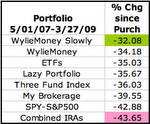
With today's nice sell off, the Lazy portfolio made up more ground, but the WylieMoney portfolio held on to its tenuous lead with a 1.98% increase since I invested on May 1st. money

moneyI have added a summary over on the right which I will update going forward. money

Today is the day I am adding fund #2

Today is the day I am adding fund #2 to the WylieMoney Slowly portfolio. Sadly, fund number 2, MDISX has closed to new investors through Etrade. It does not appear to have closed to new investors in general and Morningstar shows it available through Etrade, but you can't buy into it through their interface so I am adding a different fund (JSVAX). I'll explain more later tonight. money

A chart for Ian

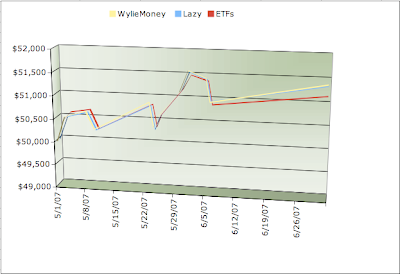
Ian gave me grief about a lack of charts so here you go. So far, everything is tracking pretty close together so the chart is not terribly informative. I did try to make it pretty...

money

Managed Mutual Funds, Index funds and ETFs...

...are going every which way these days. Since I first invested, the WylieMoney portfolio wins. Year to date, the Vanguard portfolio is ahead. And today, ETFs did the best. I will invest in fund #2 sometime this month when the time is right. money

money
I am still waiting on a response from Etrade and will try and follow up tomorrow at lunch.

I'm also switching my employer sponsored retirement plan from one of our two options to the other. I'll explain why soon. money

Finally, I leave for New Orleans this weekend and plan to write about the trip here! money

Tuesday, April 14, 2009

WylieMoney Portfolio continues to slide

Close call, but the Vanguard funds beat my picks by .02% today. My funds are still ahead since my 'purchase,' but year to date they are tied. ETFs continue to fall behind. MONEY

MONEY

Mostly Managed Portfolio Loses Ground...

...but still remains in the lead! MONEY

First of all, last week I went to Etrade's office in downtown Boston and explained my issue to Justin, who forwarded it to the 'Mutual Fund Department' with a link to this site. So if you are here looking for the details of my issue, click here or on the link in the upper right corner. Basically your site is not allowing me to set up an AIP plan with the additional minimum for AIP plans for the fund SSEMX which is $100. MONEY

On to the competition! MONEY

As of today, the WylieMoney portfolio is still ahead, but not by much. I think today's slight under performance is due to some dabbling of a few of my fund managers in emerging markets which did poorly before American markets caught fire. The year to date totals for WylieMoney and Lazy are remarkably close. I wonder how long that will last. MONEY

MONEYAnyway, I made a little chart of the the random dates that I have managed to document the total value of the accounts. This does not represent day to day performance as I only have totals from 8 days over the last month, but once I have several months of data, the graph should be loosely indicative of trends. MONEY

MONEY

Thursday, April 9, 2009

Mostly Managed vs 'Lazy' Vanguard Index funds

I promised weekly updates and failed. I'll try and come up with a good system I can keep on top of.

My negligence is not due to shame from the WylieMoney portfolio lagging behind. Far from it. Not only is the Wylie portfolio ahead since I 'hypothetically invested' in it, it has pulled ahead of the lazy portfolio year-to-date as well. Also, I realized that the reason the ETF portfolio appeared to be ahead of all the portfolios was that a few of the options, including two of the Bond funds, have not existed for a year and were being left out of the calculation so I am leaving out the ETF YTD number.

MONEYI included today's performance as well. The one-fund WylieMoney Slowly 'portfolio' is way ahead both year to date and since I 'invested' but note that its loss today is over twice that of the more balanced portfolios. And when I add the second fund in June, a Global Equity fund, I do not anticipate it will settle down...

Here are the details of each Portfolio. Click the image for a larger view:

WylieMoney

MONEYWylieMoney Slowly

MONEYETFs

MONEYLazy

MONEY

Tuesday, April 7, 2009

Oh yea... and Managed funds win again!

MONEY
I was kinda curious what would happen when the US Markets took a dive like they did today. I am pleased to report that the Wylie Portfolio won, losing hundreds of dollars, but not losing as much as the "Lazy Portfolio" of Vanguard funds or the ETFs.

Managed funds beat index funds and ETFs!

MONEY
Nice title eh?

On 5/01/07 I hypothetically invested in a portfolio of mutual funds you can buy through a single brokerage for no commissions with a $2500 minimum in each. For comparison I invested in corresponding portfolios of Vanguard Index Funds- the "Lazy Portfolio" (which you can't do- they require $3000 each to start) and ETFs (which require commissions). I also invested in a single fund from the 20 mutual funds and plan to add an additional fund each month for 20 months.

I have not decided how often I will provide updates or in what format exactly so for now I will keep it simple and once a week.

For the first week, the Wyliemoney portfolio of mostly managed mutual funds, available through Etrade, beat the Index and ETF portfolios. Note that year-to-date, the ETF and Index portfolios win. I am not paying too much attention to the single fund or "Wyliemoney Slowly" portfolio until I add a few more funds.

Saturday, April 4, 2009

The Real Scoop- Managed Funds, Index Funds or ETFs?

I just invested $152,824.12. (Hypothetically)

As promised, I have invested $50,000 in the Wylie Portfolio, $50,000 in a portfolio of Vanguard Index funds, $50,000 in a portfolio of ETFs, and $2500 in the first Wylie fund of the Wylie Portfolio. By first fund, I mean the first fund I picked: NTIAX. The extra $324.12 comes from fees required for the ETF portfolio and the exact cost of each ETF position being a little more or less than $2500.

So we have a portfolio of assorted managed funds and a few index funds you can buy through etrade for no fees, a portfolio of Vanguard index funds that you can't buy through Etrade or Vanguard for any fee because each fund has a $3000 minimum. I only invested $2500 to make the comparison simple. We have a portfolio of ETFs you can buy through Etrade for $12.99 each. And we have a version of the mostly managed portfolio I will add to one fund per month.

The purchase dates for all these portfolios is the price as of closing on 5/1/07. So if you have your own portfolio you want to compare to these, go to morningstar and create your own portfolio and enter your purchase at the price from 5/1/07. It is easy to look up historical prices. One way to do this is to go to Yahoo Finance and look up your fund or stock and click the "Historical Prices" link.

So far, the Wylie Portfolio invested in just one fund is in the lead, up 1.44% and the entire Wylie Portfolio of 20 funds is up 1.09% compared to the Vanguard Portfolio which is up 1.02% and the ETFs which are up .46%. Note that Year to Date, the Wylie Portfolio is in last place:


MONEY
Some of the ETFs have not been in existence since 1/1/07 so I am not going to put too much creed in that figure as it is not an equal comparison. I'm also not going to put much creed in performance of two days. We'll see how things look in a bit.

Here are the portfolios. Click the image for a larger view:

MONEY

MONEY

MONEY

MONEY

Monday, March 30, 2009

When to buy Mutual Funds Part III

In Part I we pondered the issues involved in deciding when to invest. In Part II we looked at a few tools and discussed some strategies to help gauge what shape the market is in. In part III we will work out a system to invest in the wylie hypothetical portfolio of 20 mutual funds.

To make the initial investment in the 20 funds I am picking, I would need $50,000. Many of these funds have $2500 initial investments, so I plan to make a hypothetical initial investment of $2500 across the board to keep things simple. Hey- it is only hypothetical money, after all.

If I was investing my hypothetical $50,000 and it was mid to late 2002, I would invest it all right away. Indeed, in 2002, I did invest the savings I had set aside to invest, as soon as I was sure I could leave it invested for a while. I wish I had $50,000 real dollars to invest in a portfolio like this at that time as many of these funds are way up over the last 5 years.

That said, I do not think today is a terrible time to invest but also it does not feel like the best time either. So to invest my $50,000 hypothetical dollars, I will invest $2500 in one fund at a time, once every month. This will spread my initial investments out over almost two years.

I also plan to invest all $50,000 in a separate portfolio, right away and I will see after the fact which approach was better.

Once I make the minimum initial purchase for each fund I will add $100 to each fund or $2000 per month into the entire portfolio. And I will keep an eye on the market and the first day each month that markets are down about 1%, I will make that subsequent purchase. Etrade actually lets me do this for now. The $100 minimum for additional investment into mutual funds is often listed as being contingent on setting up an Automatic Purchase Plan, but I have found that I can pick the day myself and make the purchase manually for mutual funds I own (which again is not all 20 of these!).

I will invest these funds in two hypothetical portfolios in Morningstar's portfolio tool, unless I find a better one by next week.

Now some of you are saying- "I do not have $50,000 or $2000 extra a month to invest so what do I care" I tried to pick funds in a specific order such that one could invest any amount between $10k and $50k and still employ a system like this one. For example one could put $10,000 in a wylie portfolio of 4 funds. Then, if one could save $400 hypothetical dollars every month or every other month or even every quarter, one could still use this system- though there is no guarantee you won't lose gobs of money so do your own research and take responsibility for your own investments!

I'll try and work out how hypothetical portfolios of fewer funds perform as well.

Finally, I want to compare my list of Etrade's best no load no fee mutual funds (in my opinion!) against a similar portfolio consisting of Vanguard index funds and also against a portfolio of ETFs.

If all the work I did picking mutual funds does not lead to a portfolio that outperforms what could be easily done with simple index tracking, that will be good for me to know when I do have $50,000 real dollars saved up after I stick with all our tips for living cheaply!

So to do this, I need to finish picking the 20 funds. I hope to set up the portfolios starting in May so expect a few more posts soon!

When to buy Mutual Funds Part II

In part I we discussed the difficulties involved in choosing when to invest. Now I will talk about a few strategies for timing investments in mutual funds. These strategies may be no better than reading the almanac or having a blindfolded monkey throw darts at a list of stocks. Regardless of whether these strategies are better than monkey darts, they provide me with an approach that takes the emotion out of the decision of when to invest which has its own value.

When everybody is selling and has been selling, it is often a good time to buy. Motley Fool wrote a nice article about this notion. Buying mutual funds on a dip is a little trickier than buying a stock on a dip. When you buy most mutual funds, you buy shares at the price of the fund as of 4 pm on the day you make the purchase. So if 3 pm comes around and the market category you are investing in is down 2% for the day, you can place a buy order and you will buy shares of a fund in that sector at a price close to 2% lower than had you bought them the day before. Of course the fund itself won’t be down 2% exactly unless it is an index fund, and even then it won’t be the exact same, but typically if the category is down, the fund will be down. Now there is nothing to say the market sector won't go down another 2% or more the next day, but if you are going to buy, buying at a slightly lower price than the day before seems like a good idea to me. My sense is that when sell-offs happen, momentum often drags good companies down with the bad so if your fund manager is making good picks and the value of the fund takes a hit from some panic selling it is a good time to buy.

Tip one: Invest on a dip.

Another concept is: money moves from sector to sector as certain kinds of companies go in and out of favor among traders. For the most part, I am not looking into ‘sectors’ with the hypothetical portfolio I am putting together on this site. Recently, Financial, Technology, and Health sectors have lagged behind Natural Resources, Utilities and until recently, Real Estate which have been on fire.

I have been choosing funds for the Wylie portfolio among Growth and Value businesses across companies of all sizes. But even in these ‘categories’, some go up while others go down. So if you have money to invest, it is not a bad idea to see which category has lagged behind. If you invest in sectors, the same concept applies.

One easy way to find out how sectors or categories are performing is to use Morningstar's free list of performance by category. This list mixes in what I am calling categories and sectors. There are many ways to build diverse portfolios, but you gotta pick one if you are going to get started and I picked categories (Large Growth, etc.).

Tip two: Invest in categories that are lagging behind.
Another thing to consider is that stock prices are generally based on some combination of how a company is doing and how investors think the company will do in the future. But investors use all sorts of different formulas to determine how profitable a company really is and to guess what impacts new products or ideas will really have. The way accounts 'expense' stock options as part of employee compensation, how the iPhone will boost or detract from Apple’s free cash flow... who knows? Part of why I am looking at mutual funds is I do not have enough time to analyze or stay on top of enough individual companies to build a good diverse portfolio.

Morningstar, pays lots of people to try and do this though, and they have a specific approach to calculating what they call Fair Value Estimates. Then they take these values and track indexes to determine if the markets those indexes track are fairly valued. Finally, they share this information for free. In part I, we looked back and saw that not buying because stocks are overvalued can lead to missed gains, but when the bubble popped, extremely high valuations were a sign that some heeded ahead of time and they were happy they did. I wish Morningstar's tool actually tracked valuations by category and included international companies as well but you get what you pay for I guess.

Tip three: Invest when markets are undervalued.

So we have three gauges to help identify good times to invest.

The general concept is, when the US market is broadly undervalued, identify which market categories specifically have underperformed and on a specific day when the market is down a good bit, buy.

No one tip or even all three will enable you to identify the perfect time to invest. Part III of this series will look at how to hypothetically jump into a Wylie portfolio like the one I am putting together on this site, using these three general ideas in a systemic way.

Thursday, March 26, 2009

When to buy Mutual Funds Part I

It is often said, "You can't time the market."

What does this mean?

In general it means you never know what will happen tomorrow.

If you thought the market was ready to slump after its nice run up before 1999 and not invested in the beginning of 1999, in some cases you would have missed the largest one year returns we may ever see in our lifetime. Data courtesy Yahoo Finance for Janus Global Technology fund:


MONEY
By all accounts, many of the stocks in this fund were trading at prices way above historical averages given what the underlying companies were earning, even before they proceeded to double in value in less than a year.

Stock prices and therefore fund prices are not driven by fundamentals, but by what people are willing to pay. Many people determine what they are willing to pay based on fundamentals, but many people do not. And in either case you still have to guess how you think the economy will do in the future. Had you invested at the beginning of 2000 thinking that this is a new economy and historical valuations do not apply because technology is going to enable corporate growth to expand at levels never before imagined, you would have been very sad by the end of 2002. Again consider Janus Global Technology:

MONEY
Since 2002, markets around the world have gone up, almost across the board. Small and large company stocks have increased. Growth and value oriented companies have done well. Historically when oil prices have soared, economies have struggled as the added cost of manufacturing and transportation have been factored into the price of goods, lowering sales or reducing profits. Recently this has not been the case as companies across all sectors have grown and earned significant profits. Some claim tax cuts in the US are the cause, but European markets despite much higher taxes have trounced American markets so I am hesitant to attribute any single factor to these trends. Despite a long run of gains, stock price valuations are nowhere near as high as they were in 2000. So what does all this mean?

Beats me, I'm a philosophy major.

Some claim that current valuations are too high as they are calculated anticipating that above average growth will continue for a while which is possible, but unlikely given historical trends.

Some think the economy is ready to pick up steam. Would you trust this guy?

MONEY
Others say things are not good, not bad.

One of the reasons the hypothetical portfolio I am creating here only holds funds that allow $100 or smaller subsequent investments is to not have to figure out how to time the market. My thinking is that if I buy a fund and contribute $100 every month, every 2 months or once a quarter, the exact timing of each purchase will not have a significant impact over the long term as the cost of the overall holdings will be the average of each purchase through up and down markets. If the sector the fund invests in grows and the fund managers make good picks, I should come out ahead.

I agree that you can not time the market, but you do have to determine a time to make the initial investment. And no advice works in every situation. If you had cash to invest in January 2000, the notion that you can't time the market so just buy when you have the cash, would not have been good advice. So even though I agree with the claim that you can't time the market, there are, good and bad times to invest and more importantly good and bad strategies for investing. And even if you buy into the Wylie idea of regular contributions, you still have to make the initial purchase which for the funds I am looking at are often a minimum of $2500.

So even though you cannot predict how markets will perform there are a couple of tools out there that you can use to see if it is a good time to buy or not and hopefully avoid buying at a market peak.

In part II I will talk about these tools and lay out a strategy for hypothetically investing in the Wylie hypothetical portfolio. Then I will pick the last few funds necessary to round out the portfolio and begin tracking the performance of the portfolio.

Tuesday, March 24, 2009

What investment records should you keep?

Keep them all. money

Lots of financial sites and blogs post articles offering advice about what records to keep in general: bankrate, soundmoneytips, realsimple, even the IRS has made an attempt.

As is often the case, Morningstar has one of the best explanations for why this matters when it comes to investment records. money

I keep every monthly statement from my brokerage and have a file over 2 1/2 inches deep to show for it. I wish this was an indicator of massive wealth, but really it is just a symptom of reinvested dividends. money

MONEY
If you put $500 in a growth and income fund and reinvest the dividends and capital gains, each payment- in cents, dollars, whatever, is a transaction on the statement. And at the end of the year, you pay income taxes on those payments, even though they are (re)invested, and not cash in your pocketses. So if you do not have a ton of money (yet!), but still want to diversify broadly and put a small amount of money in a number of funds instead of just piling it all into one, your statements get long. money

Some of the new retirement funds like Vanguard Target Retirement 2050 are actually a collection of funds, so you can put all or some of your money in one of these, even if you do not plan to save it until retirement, and diversify that way, but I digress money

Some brokerages are no longer sending paper statements automatically and actually charging investors for this 'privilege.' Here is Ameritrade, disclosing its fees:

MONEYSo if you only get electronic statements, or opt to get electronic only, you have to keep those too. And back them up! money

I finally got my 3rd and 4th brokerage account tax statements. One of these adjustments changed how $22.46 was allocated for tax purposes. I waited a month and a half to file my taxes because of how $22... good grief. money

So anyway, I sold a fund last year and I knew how much I originally invested, and Etrade does a good job of keeping track of funds that have automatically reinvested since they bought my account from my previous brokerage. My old records, however, did not convert to my Etrade account so I had to go back through my paper records starting in 2000 when I bought the fund to calculate my actual basis. This took me about 3 minutes to do because I had all my records in order and this changed my basis by a couple of hundred dollars which lowered my tax bill enough to buy a decent bottle of wine! Or, if I shop at Trader Joe's, 3 or 4 decent bottles of wine! money

So the lesson here is that you should keep your statements, paper or electronic, because your brokerage may be bought by a competing brokerage, or it may raise its fees and you may transfer your account to a better brokerage and all your details may not transfer over. And unless you want to pay the tax man (or woman) for the same profits twice, you'll want to be able to add up your actual basis, not just the amount you originally invested and having your statements handy and organized makes this pretty easy. money

Thursday, March 19, 2009

The Wylie portfolio vs Lazy and Kevin!

After yesterday's sell off, I went back and looked at the one day performance of my recommendations compared to the lazy portfolio. I anticipated that my managed funds (Well the NTIAX is an index fund but the others are managed) would have under performed Vanguard's low cost index funds. Now let me be clear- this is not an apples to apples comparison. My allocation is not invested in the same categories as the lazy portfolio. But if somone came to me and said- "I want to invest $10,000 in some mutual funds.., any funds worth researching?" These are the one's I would think about... money

After realizing my funds did not lose as much, I ran the numbers on Kevin's actual allocation too. money

MONEYI am not sure what this indicates exactly- the Vanguard funds invest very broadly so maybe this simply means that yesterday's sell off was very broad and that my funds were a little better positioned for this round. All my stock funds did better than the Vanguard stock funds but the real difference was my bond fund which is a not at all like the broad Vanguard bond fund of the lazy portfolio. money

Anyway- not much use in looking at daily performance of funds for the kind of investing I am exploring- except to be sure you can stomach some sadness. money

Misleading article about building a 'lazy' portfolio.

Paul Farrell wrote an article the tone of which is "even a second grader can invest in a simple portfolio and beat the market." As I started to read through this, I saw several things that bugged me so I decided to explore in greater detail. money

The first thing that stands out is that to set up this portfolio you need a parent who has enough invested at Vanguard to waive the minimum requirements for each fund. So not any second grader could do this but second graders with parents who have some unspecified amount of wealth invested at Vanguard can do this. money

Let's assume that not everybody has parents with huge investments at Vanguard but is looking for a way to begin investing. Does this approach still make sense? From what I can tell after poking around on Vanguard's site, this simple portfolio would be assessed a $30 annual fee until little Kevin's account was worth at least a quarter of a million dollars. In addition to that, each individual fund has another annual $10 fee until each holding is worth $10000. money

So this lazy portfolio would cost $60 per year in fees. Now $60 is only a very small percentage of $9000 and these funds have very low expenses assessed within the funds themselves, but these fees make me mad anyway and should at least be mentioned. money

Then, what really caught my eye was this chart which is terribly deceptive:

MONEYThe $3000 minimums listed do not represent the allocations used to calculate the actual returns. There is a column called "Allocation" that clarifies the actual allocation used to calculate the returns, but these allocations are not allowed in Vanguard funds to for the typical investor with this much to invest. So for those of us whose parents don't have their nest eggs socked away at Vanguard, this portfolio, with equal $3000 amounts invested in each fund, would have under performed the S&P 500 over a 1 year period, not out-performed it as listed. And the performance above the S&P over the 5 and 10 year periods would not have been as great and none of these returns factor in the $60 in annual fees. Again these fees are not huge but over 10 years they total $600. 1, 5, and 10 year annualized returns with equal weight in the 3 funds would have been: 15.45% 9.38% 7.44% -not shabby, but not what is listed.

I do not want to be too critical of Mr. Farrell because I appreciate his approach in general: to advocate simple, diversified low cost portfolios that take very little management. But part of why I started my project was because none of the pundits writing about various methods for building portfolios actually ground their recommendations in the real world with portfolios you can really build with little money to start and with clarity about the fees. money

What I am doing on my blog is using Etrade to propose a portfolio that you can actually buy, with $2500 minimums and no fee $100 monthly additions. Etrade has a $10,000 account minimum or an absurd $40 per quarter fee. So my hypothetical picks would not be good for someone with only $9,000 either. But if you have the $10,000 total, there is no individual fund fee or account fee in addition to this if you are using Etrade. The first four funds I recommend with $2500 minimums in each would total $10,000 but you should be sure and add a little more than this to avoid Etrade's absurd $160 annual fee in case these funds lose value in the short term. money

I've written before about my issues with coming up with accurate statistics- indeed the chart above does not clarify if dividends are reinvested or not to achieve these averages. But I am going to show you the results of my picks according to the same source Mr. Farrell uses so you can compare: money

MONEYThe lazy portfolio beat my hypothetical portfolio over the past year, but my portfolio come out ahead over 3 and 5 year periods. The Mid Cap Growth fund I recommended has not been around for 10 years so I cannot compare a total 10 year performance, but the other three funds I recommend have all outperformed every one of the Vanguard funds over 10 years. money

My point in all of this is that it would be nice if people talking about how simple it is to invest would be clear about fees and minimums and use actual, possible scenarios that anyone can follow (at their own risk of course!). money

Tuesday, March 17, 2009

Picking a Brokerage

I know a number of folks in the process of rolling old 401(k)s into IRAs or setting up brokerages for the first time. I have discussed the pros and cons of a few brokerages with a few folks, but the truth is, it is hard to compare because the offerings, fee structure, and resources available are very different from firm to firm and there is not a good website that I can find that really compares it all. That said, smartmoney.com has done a nice job of categorizing several brokerages and rating them. They do not explain every feature so you should do more research- but this is a good list of brokerages and summaries of who they might best serve. money

I use etrade, because my original brokerage was bought by another brokerage that merged with another that was bought by etrade. This process has not been fun- especially given that my historical records have not been carried over from company to company. money

Despite the fact that my experiences with etrade have mirrored those described in the article, I am not surprised that they rated etrade #2 under their premium brokerage category. I got a kick out of (but do not completely agree with) their summary concerning many of the etrade critics that- "...much of (their/our) griping may stem from resistance to change."

Given a plan like my hypothetical non-retirement portfolio of mutual funds that allow $100 monthly or quarterly contributions for NO fee- etrade seems like the best bet.
money

The bottom line is that when choosing a brokerage- you need to figure out what you want to do with it and how much help you will need doing it. If you are going to roll-over an IRA and invest it in a couple of funds and forget about it until you retire, you do not need a brokerage that offers a ton- just one with the lowest fees possible. If you want to invest actively and do not need help from your brokerage and are ok with really poor customer service, etrade may be your best bet. Smartmoney also mentions: "
Lilien, the firm's president, says E*Trade plans to spend an extra $42 million on customer service this year."

Motleyfool has another resource to help you pick a brokerage- I like the comparisons it makes and the info it looks at but it only reviews 4 companies.
money

WYLIE MONEY